
Blog / Olathe Hyundai Dealer

Blog

All Olathe Hyundai Dealer McCarthy Olathe Hyundai Service Olathe Hyundai Service Olathe Used Cars

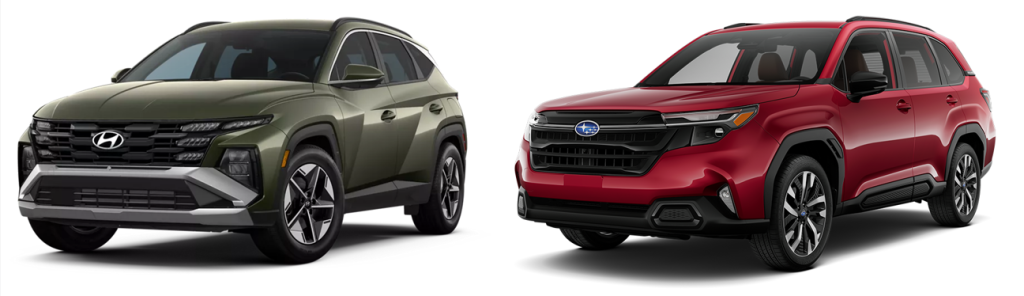
Hyundai Tucson vs Subaru Forester

Which Compact SUV Is Right for You in Olathe, KS? If you're shopping for a capable compact SUV around Olathe, KS, the Hyundai Tucson and Subaru Forester are both likely on your list. Each offers everyday practicality, modern safety technology, and the flexibility families and commuters want. But when you compare performance, cargo space, technology, and long-term value, the Hyundai Tucson makes a strong case for itself. At McCarthy Hyundai of Olathe, we think the Tucson stands out for drivers who want a comfortable ride, a modern interior, strong feature content, and excellent ownership value. If you want to explore available options now, browse our new Hyundai Tucson inventory or shop our full new Hyundai inventory in Olathe, KS. Quick Summary The Hyundai Tucson is a smart choice for drivers who want strong everyday comfort, impressive cargo space, modern technology, and excellent long-term ownership value. The Subaru Forester remains a practical competitor, especially for shoppers focused on standard all-wheel drive, but the Tucson delivers a more well-rounded package for many compact SUV buyers in Olathe and the Kansas City area. Table of Contents Hyundai Tucson vs Subaru Forester Overview Performance and Efficiency Interior Space and Cargo Technology and Safety Value and Ownership Which SUV Should You Choose? Frequently Asked Questions Hyundai Tucson vs Subaru Forester Overview The compact SUV market is packed with strong options, which is why the Hyundai Tucson and Subaru Forester continue to attract so much attention. Both models offer practical dimensions, seating for five, and the kind of flexibility drivers want for commuting, errands, road trips, and family life. The Forester is known for its standard all-wheel drive and straightforward utility. The Tucson, meanwhile, offers a more refined overall experience with strong cargo capacity, smooth transmission tuning, modern infotainment features, and standout warranty coverage. For many drivers, that balance makes the Tucson the better all-around fit. If you're still narrowing down your options, you can start at our Hyundai dealership homepage, browse our Hyundai Tucson inventory, or explore our used inventory in Olathe if you're comparing different price points. Side-by-Side Comparison Feature Hyundai Tucson Subaru Forester Starting MSRP $28,750 $29,695 Engine 2.5L I4, 187 hp 2.5L Boxer I4, 182 hp Torque 178 lb-ft 176 lb-ft Transmission 8-speed automatic CVT Drivetrain FWD or available AWD Standard AWD EPA MPG (city/highway) Up to 26 / 33 Up to 26 / 33 Passenger Volume 108.2 cu. ft. 111.6 cu. ft. Max Cargo Volume 80.3 cu. ft. 74.2 cu. ft. Infotainment Standard 8-inch touchscreen; available larger display and digital cluster Standard 8-inch touchscreen; available larger vertical screen Warranty 10-year/100,000-mile powertrain warranty 5-year/60,000-mile powertrain warranty Pricing and specifications can change. Be sure to verify current trim details and availability with McCarthy Hyundai of Olathe. Performance and Efficiency The Hyundai Tucson's 2.5-liter engine delivers 187 horsepower, giving it a slight edge over the Subaru Forester's 182-horsepower 2.5-liter Boxer engine. While the numbers are close, the Tucson pairs its engine with an 8-speed automatic transmission, which many drivers may prefer over the Forester's continuously variable transmission when it comes to feel and responsiveness. The Forester's standard all-wheel drive is a plus for some shoppers, especially those who prioritize year-round traction. But the Tucson offers available all-wheel drive as well, letting drivers choose the setup that best fits their needs and budget. Fuel economy is competitive between the two SUVs, with both offering up to 26 MPG city and 33 MPG highway in certain configurations. The Tucson also offers added flexibility through electrified options in the broader Tucson lineup, which may appeal to drivers who want even more efficiency. If you want to compare trims in person, you can browse our new Hyundai Tucson inventory or view our full new Hyundai inventory. Interior Space and Cargo The Subaru Forester offers a bit more passenger volume on paper, which may matter to some drivers focused primarily on cabin openness. Still, the Hyundai Tucson pulls ahead in a key area many SUV shoppers care about most: cargo capacity. With the rear seats folded, the Tucson offers up to 80.3 cubic feet of cargo room, compared with the Forester's 74.2 cubic feet. That extra space can make a real difference when you're loading luggage, sports equipment, groceries, home-improvement supplies, or gear for a weekend road trip. The Tucson also brings a more modern cabin layout, with a clean dashboard design and available upscale touches that help it feel more refined inside. For families and commuters who want versatility without moving into a larger SUV segment, the Tucson is easy to appreciate. If you're looking for a vehicle with room for passengers and gear, you can also explore other options in our used inventory or stop by McCarthy Hyundai of Olathe to compare models in person. Technology and Safety The Hyundai Tucson delivers a strong mix of connectivity, comfort, and convenience features. Depending on trim, drivers can enjoy a modern touchscreen layout, available digital displays, Apple CarPlay®, Android Auto™, and a user-friendly cabin experience that feels current and well organized. The Subaru Forester also offers useful infotainment and driver-assist technology, but the Tucson stands out for its polished digital presentation and the value it brings across the lineup. Hyundai SmartSense safety features help add confidence behind the wheel, and many drivers will appreciate how easy the Tucson is to live with day to day. Long-term ownership confidence is another major advantage. The Tucson is backed by Hyundai's 10-year/100,000-mile powertrain limited warranty, which significantly exceeds Subaru's powertrain warranty coverage. For many buyers, that added peace of mind can be just as important as horsepower or cargo capacity. When it comes time for routine maintenance, our Hyundai service center in Olathe is here to help keep your vehicle in top shape. Value and Ownership Value is about more than just a starting price. It also includes warranty coverage, standard and available features, cargo flexibility, technology, and how the vehicle feels to own over time. In that broader comparison, the Hyundai Tucson stands out as a compelling option. The Tucson starts at a lower MSRP than the Forester in the comparison you provided, while also offering more maximum cargo room and a much stronger powertrain warranty. That combination gives drivers more confidence that they're getting solid everyday usability along with long-term ownership support. For many shoppers in Olathe and the surrounding Kansas City area, the Tucson hits the sweet spot between comfort, practicality, and value. If that sounds like the kind of SUV you're after, our Hyundai Tucson model page is a great place to start. Which SUV Should You Choose? The Subaru Forester remains a capable compact SUV, especially for shoppers who want standard all-wheel drive and a practical design. But the Hyundai Tucson makes the stronger overall case for many buyers thanks to its smooth 8-speed automatic transmission, generous cargo room, modern cabin, strong feature content, and outstanding warranty protection. If you want a compact SUV that feels ready for commuting, errands, family travel, and everyday life in Olathe, the Hyundai Tucson is well worth a closer look. Browse our new Tucson inventory, view our full new Hyundai lineup, or contact McCarthy Hyundai of Olathe to schedule a test drive. Frequently Asked Questions Is the Hyundai Tucson bigger than the Subaru Forester? Both are compact SUVs with roomy interiors, but the Forester offers slightly more passenger volume while the Tucson offers more maximum cargo space with the rear seats folded. Does the Hyundai Tucson have more cargo space than the Subaru Forester? Yes. Based on the comparison figures provided, the Hyundai Tucson offers up to 80.3 cubic feet of maximum cargo space, while the Subaru Forester offers up to 74.2 cubic feet. Which SUV has the better warranty, the Hyundai Tucson or Subaru Forester? The Hyundai Tucson offers stronger powertrain warranty coverage, with a 10-year/100,000-mile powertrain limited warranty compared with Subaru's 5-year/60,000-mile powertrain warranty. Does the Hyundai Tucson offer all-wheel drive? Yes. The Hyundai Tucson is available with all-wheel drive, giving drivers added confidence for changing road and weather conditions. Where can I shop for a Hyundai Tucson in Olathe, KS? You can browse the Hyundai Tucson inventory at McCarthy Hyundai of Olathe, explore the full new inventory, or visit our dealership in person. Sources Hyundai USA - Tucson Overview Hyundai USA - Tucson Specs Subaru USA - Forester Overview CHUNK 13: FAQ SCHEMA CHUNK 14: ARTICLE SCHEMA
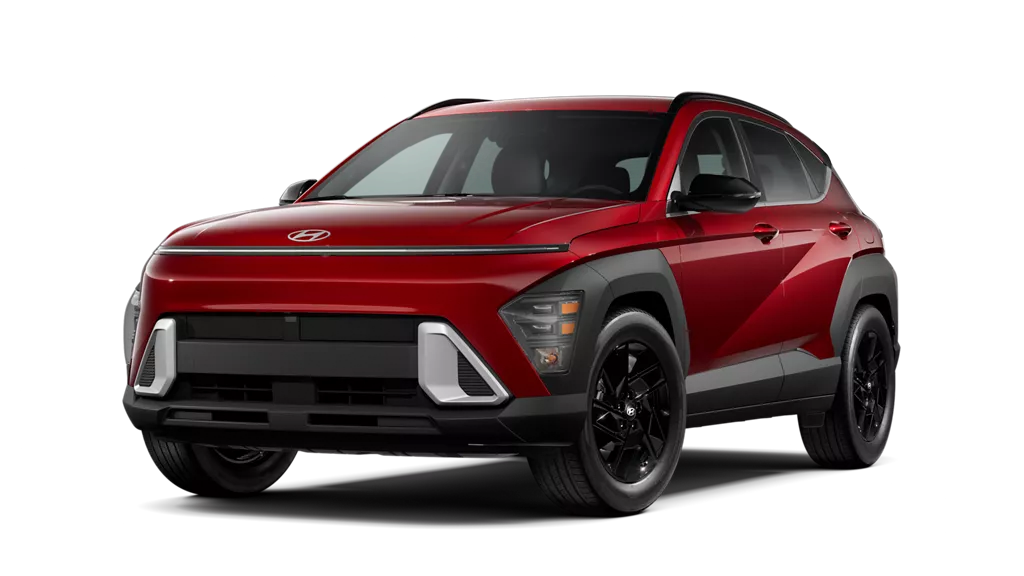
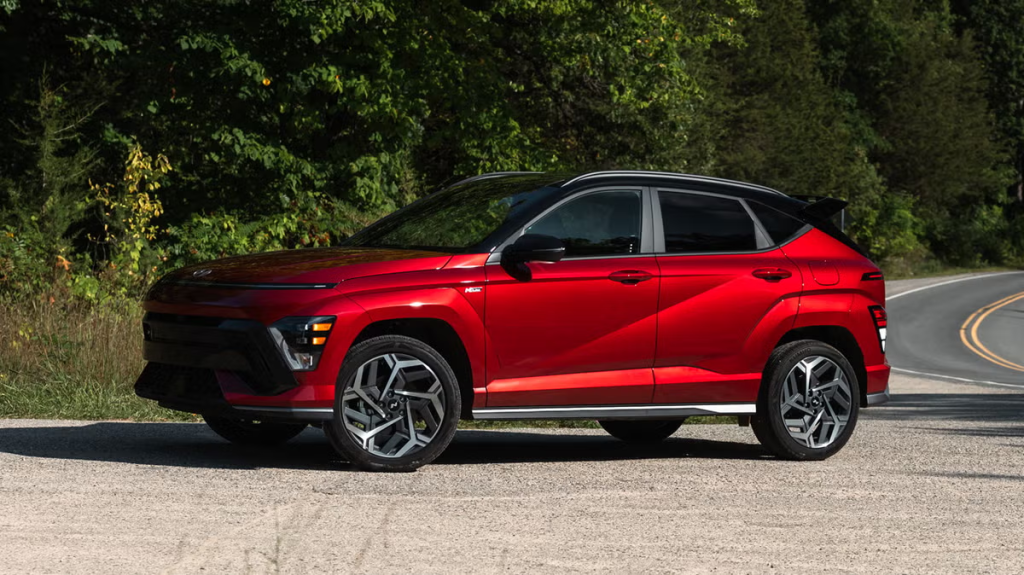
2026 Hyundai Kona front three-quarter view in red

2026 Hyundai Kona vs Volkswagen Taos

Which Compact SUV Is Right for You in Olathe, KS? If you're shopping for a compact SUV that feels modern, efficient, and easy to enjoy every day, the 2026 Hyundai Kona and Volkswagen Taos are both worth a closer look. Both models bring practical sizing, smart technology, and everyday comfort to the table, but the Kona stands out for many Olathe drivers thanks to its bold styling, available turbocharged performance, and upscale tech features. At McCarthy Hyundai of Olathe, we think the 2026 Hyundai Kona is a strong choice for drivers who want a compact SUV that feels confident on the road and comfortable in daily life. If you want to see available models, browse our new Hyundai Kona inventory or explore our full new Hyundai inventory in Olathe, KS. 2026 Hyundai Kona Volkswagen Taos CHUNK 2: SUMMARY Quick Summary The 2026 Hyundai Kona is a smart pick for drivers who want bold styling, available 190-horsepower turbo performance, a large available 12.3-inch display setup, available HTRAC AWD, and strong peace of mind from Hyundai warranty coverage. The Volkswagen Taos remains a practical competitor, but the Kona offers a more modern feel and a feature mix that will appeal to many compact SUV shoppers looking for comfort, technology, and value. CHUNK 3: TABLE OF CONTENTS Table of Contents 2026 Hyundai Kona vs Volkswagen Taos Overview Design and Interior Space Performance and Efficiency Technology and Safety Which SUV Should You Choose? Frequently Asked Questions CHUNK 4: OVERVIEW 2026 Hyundai Kona vs Volkswagen Taos Overview The compact SUV segment is crowded for a reason. Drivers want something efficient, flexible, and comfortable enough for commuting, errands, road trips, and weekend plans. The 2026 Hyundai Kona and Volkswagen Taos both fit that description, but they do it in different ways. The Taos focuses on practicality and clean Volkswagen styling, while the Kona brings a more distinctive design, a tech-forward cabin, and available performance upgrades that give it a more energetic personality. For many shoppers, especially those comparing features per dollar, the Kona feels like the more complete package. If you're still deciding between models, you can start with our Hyundai dealership homepage, check current Hyundai Kona availability, or explore used SUVs for sale in Olathe if you're comparing price points as well. CHUNK 5: DESIGN Design and Interior Space The 2026 Hyundai Kona has a more contemporary look than many rivals in the segment. Its crisp lighting design, clean dashboard layout, and available upscale touches help it feel more premium than you might expect from a compact SUV. Inside, the Kona offers a roomy layout for five passengers and a cabin that feels intentionally designed around modern drivers. According to Hyundai's official specifications, the 2026 Kona offers available features like H-Tex trimmed seating, an 8-way power driver's seat, heated and ventilated front seats, and a large available 12.3-inch navigation display. That gives the cabin a more upscale impression, especially for drivers who care about comfort and everyday usability. The Volkswagen Taos also delivers a useful and comfortable interior, but many shoppers may find the Kona's overall layout and display design more modern. If style and in-cabin technology matter to you, the Hyundai Kona has a noticeable edge. Want to see the Kona in person? Browse our new Hyundai Kona inventory or visit McCarthy Hyundai of Olathe to compare trims. CHUNK 6: PERFORMANCE Performance and Efficiency One of the biggest reasons to put the 2026 Hyundai Kona at the top of your list is its available turbocharged performance. Hyundai offers an available 190-horsepower 1.6L turbocharged engine on select trims, paired with an 8-speed automatic transmission. That setup gives the Kona a more responsive and confident feel when merging, passing, or simply enjoying your daily drive. The 2026 Volkswagen Taos offers 174 horsepower and 184 lb-ft of torque, which is competitive for the class. It also offers available all-wheel drive. But for drivers who want stronger available output, the Kona has the horsepower advantage. Efficiency is another reason the Kona deserves attention. Hyundai lists the 2026 Kona at up to 35 MPG highway depending on trim and drivetrain, making it a practical option for drivers with longer commutes around Olathe, Overland Park, Lenexa, and the greater Kansas City area. If you want a compact SUV that feels easy to live with every day but still gives you access to available turbo power, the Kona strikes an excellent balance. You can explore current trim availability through our new Hyundai inventory page or compare it with budget-friendly options in our used inventory. CHUNK 8: DECISION Which SUV Should You Choose? If you want a compact SUV with a clean design, practical sizing, and a comfortable ride, the Volkswagen Taos is still worth considering. But if your priorities include available turbocharged performance, standout styling, modern infotainment, available upscale cabin features, and long-term ownership confidence, the 2026 Hyundai Kona is the better fit for many drivers. For shoppers in Olathe, KS, the Kona is especially appealing because it blends city-friendly maneuverability with road-trip versatility and a premium feel that punches above its class. Whether you're upgrading from a sedan, downsizing from a larger SUV, or shopping for your first new crossover, the Kona deserves a serious look. Ready for the next step? Browse our 2026 Hyundai Kona inventory, view our full new Hyundai lineup, or contact McCarthy Hyundai of Olathe to schedule a test drive. CHUNK 9: FAQS Frequently Asked Questions Is the 2026 Hyundai Kona bigger than the Volkswagen Taos? Both are compact SUVs with seating for five, but their packaging is a little different. The best way to decide which feels better for your needs is to compare interior comfort, cargo versatility, and front-seat layout in person at McCarthy Hyundai of Olathe. Does the 2026 Hyundai Kona have more horsepower than the Volkswagen Taos? Yes, the 2026 Hyundai Kona offers an available 190-horsepower turbocharged engine, while the 2026 Volkswagen Taos is rated at 174 horsepower according to official manufacturer information. Is the 2026 Hyundai Kona good for commuting around Olathe and Kansas City? Yes. The Kona is a strong commuter SUV thanks to its compact size, available all-wheel drive, available turbo power, and highway efficiency of up to 35 MPG on certain trims. Does the Hyundai Kona have good safety ratings? The Hyundai Kona has earned strong safety recognition, including IIHS Top Safety Pick+ recognition for the 2025-26 model range in the small SUV category. Where can I shop for a Hyundai Kona in Olathe, KS? You can browse available models through our Hyundai Kona inventory page, explore our full new inventory, or stop by McCarthy Hyundai of Olathe. CHUNK 10: STRATEGIC EXTERNAL LINKS / SOURCES Sources 2026 Hyundai Kona Overview | Hyundai USA 2026 Hyundai Kona Features and Specs | Hyundai USA 2026 Volkswagen Taos Overview | Volkswagen IIHS 2025 Top Safety Pick+ Winners | Small SUVs CHUNK 11: FAQ SCHEMA CHUNK 12: ARTICLE SCHEMA

EV vs. Hydrogen Fuel Cell: What’s the Difference?

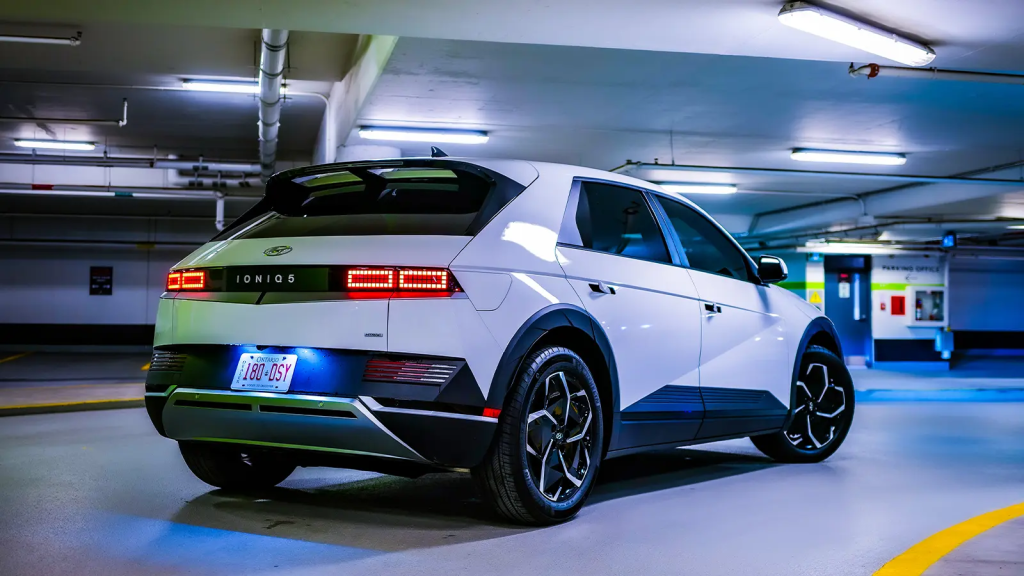
Summary: Electric vehicles are everywhere these days, but hydrogen fuel cell vehicles are still a bit of a mystery to most people, especially here in the Midwest. So what exactly is the difference between the two, and is one actually better than the other? In this post we break down how each technology works, the pros and cons of both, and why EVs have pulled so far ahead in popularity, so you can figure out which one makes the most sense for you. Table of Contents EV vs Hydrogen Fuel Cell Overview Electric Vehicles Pros of Electric Vehicles Cons of Electric Vehicles Hydrogen Fuel Cell Vehicles Pros of Hydrogen Fuel Cell Vehicles Cons of Hydrogen Fuel Cell Vehicles Why Are EVs More Popular Than Hydrogen Fuel Cells? Frequently Asked Questions INTRO EV vs Hydrogen Fuel Cell Overview At this point just about everyone understands the basics of electric vehicles. You have probably driven past a few of them in traffic recently, and you may even know someone who owns one. However the same cannot really be said for hydrogen fuel cell vehicles, especially if you live here in the Midwest. Despite their relative obscurity, hydrogen fuel cells have actually been around for years and they have a few genuine advantages compared to EVs. So is one actually better than the other? Which one is right for you? Let us break it all down. ELECTRIC VEHICLES Electric Vehicles The idea behind an electric vehicle is straightforward. Instead of an internal combustion engine that burns fuel to power the car, electric cars use a rechargeable high-voltage battery. While they are not quite as widespread as hybrids or traditional gas-powered cars just yet, EVs are steadily gaining more and more converts every year thanks to rapidly improving battery technology. EV PROS Pros of Electric Vehicles One of the biggest financial benefits of owning a battery electric vehicle is that they are cheaper to operate than a car with an internal combustion engine. It simply costs less money to drive an EV an equivalent number of miles, even if you are recharging at a public station, because electricity is a far more plentiful resource than gasoline. Electricity prices are also more stable, which means you no longer have to stress about fluctuating gas costs every time you pull up to a pump. There are other ways to save with EVs too. Depending on the specific model, U.S. buyers may be eligible for significant federal and local government tax credits that can go a long way toward offsetting the higher upfront price tag. On top of that, EVs allow for convenient at-home charging, which can almost completely eliminate the need to rely on public charging stations for your everyday driving needs. EVs also tend to come with noticeably lower service bills over time. Because they have fewer mechanical parts than gas engines and do not rely on as many fluids to keep things running smoothly, routine maintenance is simpler and less frequent. That means no more oil changes. Another underrated benefit of electric vehicles is their driving performance. Because electric motors deliver torque almost instantly, EVs accelerate significantly faster than a comparable gas-powered car, which makes for a genuinely fun and responsive driving experience. EV CONS Cons of Electric Vehicles The most common concern shoppers bring up when considering an EV is range anxiety. In reality though, many recently released electric vehicles offer range that is just as good or better than a gas-powered car. The Hyundai IONIQ 6 for example can travel up to 361 miles on a single charge, which is impressive by any standard. That said, pure range is not the only factor to consider. People who live in more rural communities may not have easy access to EV charging infrastructure, particularly if they do not have a reliable home charging setup. Not everyone has the option of living close to a dense network o HYDROGEN FUEL CELL VEHICLES Hydrogen Fuel Cell Vehicles Hydrogen fuel cell vehicles are also known as fuel cell electric vehicles or FCEVs. Instead of a rechargeable battery, they use high-pressure hydrogen gas as their fuel source. The hydrogen is pumped into a tank and then mixed with oxygen from the surrounding air, which causes a chemical reaction that generates electricity to power the vehicle. The only byproduct of this entire process is water vapor, making FCEVs one of the cleanest forms of transportation available today. HYDROGEN PROS Pros of Hydrogen Fuel Cell Vehicles Hydrogen fuel cell vehicles share a lot of the same core benefits as battery electric vehicles. Because they do not emit harmful greenhouse gases, they contribute far less to air pollution compared to traditional internal combustion engine vehicles. FCEVs also tend to offer more range than the average electric vehicle. As a real world example, the 2023 Hyundai NEXO Fuel Cell is rated for 380 miles on a single fill, whereas many entry-level EVs tend to get closer to 200 miles on a single charge. That extra range can make a meaningful difference for drivers who cover a lot of ground on a regular basis. Refueling is another area where hydrogen fuel cell vehicles have a clear edge over EVs. Filling up a hydrogen tank is much quicker than charging a battery and is much more comparable to a standard trip to a gas station, which makes the ownership experience feel a lot more familiar for drivers who are used to traditional vehicles. HYDROGEN CONS Cons of Hydrogen Fuel Cell Vehicles Hydrogen fuel cell technology is still relatively new in mass-produced consumer vehicles, which largely explains why FCEVs tend to be significantly more expensive than both EVs and gas-powered cars. They also do not benefit from nearly as many potential tax credits as electric vehicles, which makes the price gap even harder to close for most buyers. Hydrogen itself is also expensive to produce due to its relative rarity as a readily available fuel source. This can result in fuel costs that are even higher than gasoline in some cases, and it has also contributed to some fairly serious supply shortages in markets where FCEVs are available. But without a doubt the biggest and most immediate drawback of hydrogen fuel cell vehicles is their availability. As of right now in the United States, FCEVs can only be purchased in California. No other state currently has the hydrogen refilling infrastructure needed to support them, which means that if you live here in Kansas or anywhere else in the Midwest, an FCEV is simply not a practical option at this point in time. WHY EVS MORE POPULAR Why Are EVs More Popular Than Hydrogen Fuel Cells? For a little while it genuinely looked like EVs and FCEVs were going to have a close competition to see which one became the dominant green automotive technology. So how is it that you can find electric vehicles in all 50 states while FCEVs are only sold in one? Why did electric vehicles pull so far ahead? According to researchers at MIT, higher production costs and a lack of infrastructure are the two main reasons hydrogen fuel cell vehicles have not gained the same traction as EVs in 2024. Because FCEVs are more expensive to manufacture, automakers simply do not have enough financial incentive to bring them to market at scale. On top of that, building out hydrogen refilling infrastructure is a much more complex undertaking than expanding EV charging networks, because it requires shipping hydrogen across the country and building entirely new refilling stations from scratch. EVs on the other hand allow automakers and city planners to tap into electrical grids that already exist everywhere. That said nobody can say for certain which technology will come out on top in the years ahead. Both are improving steadily, and there may still be a very bright future for hydrogen fuel cell vehicles down the road. It is definitely a space worth keeping an eye on. FINAL CTA In the meantime, if you are ready to make the switch to an electric vehicle, McCarthy Olathe Hyundai has you covered. We have the Hyundai IONIQ 5 and IONIQ 6 in stock and ready to go. Give us a call at (913) 324-7200 to ask about our finance specials and find out how you can save thousands off the price of a new EV today. FAQs Frequently Asked Questions What is the difference between an EV and a hydrogen fuel cell vehicle? An EV runs on a rechargeable high-voltage battery that you charge using electricity. A hydrogen fuel cell vehicle uses compressed hydrogen gas that reacts with oxygen to generate electricity and power the motor, emitting only water vapor in the process. Are hydrogen fuel cell vehicles available in Kansas? No. As of 2024, hydrogen fuel cell vehicles are only available for purchase in California due to the lack of hydrogen refilling infrastructure in other states including Kansas. How long does it take to charge an electric vehicle? With 800-volt DC fast charging, the IONIQ 6 can charge from 10% to 80% in under 20 minutes. Most public DC chargers operate at lower voltages, which can mean 40 to 50 minutes of charging time depending on where you stop. Do electric vehicles qualify for tax credits? Yes. Depending on the model, U.S. buyers may qualify for significant federal and local tax credits on electric vehicles, which can help offset the higher upfront purchase price considerably. Why are EVs more popular than hydrogen fuel cell vehicles? According to MIT researchers, higher production costs and lack of refilling infrastructure are the two main reasons FCEVs have not gained the same traction as electric vehicles, which can tap into existing electrical grids across all 50 states. SCHEMA MARKUP

McCarthy Auto group Santa fe

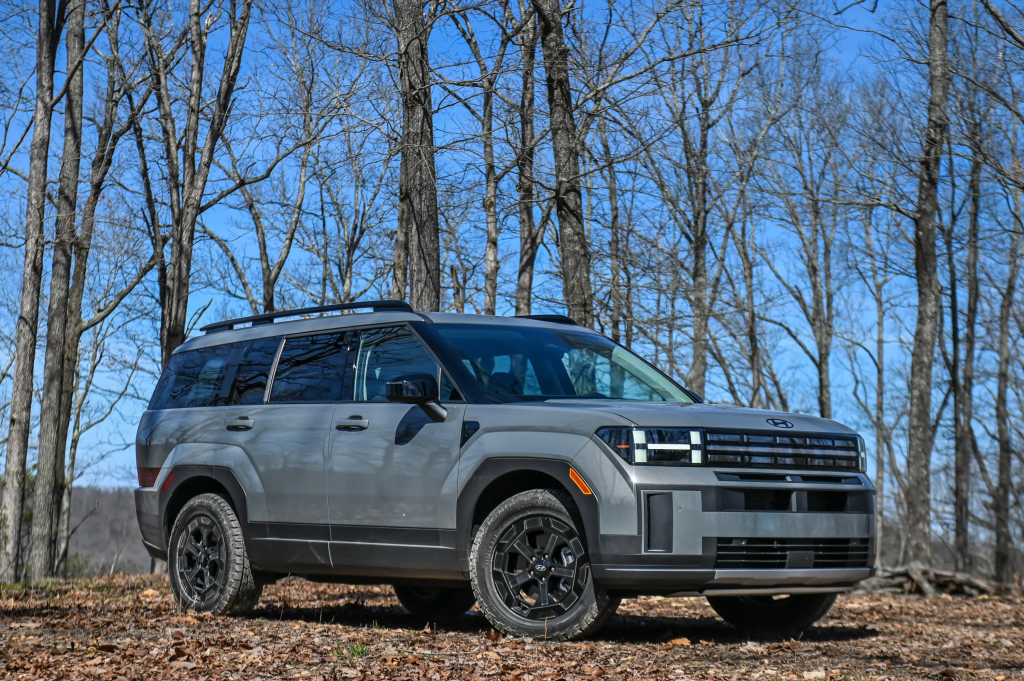
2024 Hyundai Santa Fe XRT Review: Does it Overland?

If you have been eyeing the all-new 2024 Hyundai Santa Fe XRT but wondering whether it can actually handle real adventure, we put it to the ultimate test. We packed it up, hooked up a teardrop camper, and spent a full week glamping and campsite hopping in the great outdoors. From cargo space and towing to tech features and off-road capability, here is everything you need to know about the 2024 Santa Fe XRT straight from real-world experience. Table of Contents 2024 Hyundai Santa Fe XRT Overview Preparation and Packing Driving Dynamics and Tech Features Campsite Hopping and Real World Use Final Verdict Frequently Asked Questions INTRO 2024 Hyundai Santa Fe XRT Overview By now you have probably heard about the all-new 2024 Hyundai Santa Fe, which has gone through quite the massive redesign. In a lot of ways it looks and feels like a completely new SUV from the ground up. Now that it has finally hit our lot at McCarthy Olathe Hyundai, we simply could not wait to put it through its paces. To really give it a proper test, we decided to pack it up for a full week of glamping and general shenanigans out in the country using the off-road-ready XRT trim. Here is everything we discovered about the 2024 Santa Fe after living out of it for seven days straight. PREPARATION AND PACKING Preparation and Packing The first step of any successful trip is getting your supplies together and loading up the car. We had two adults on this trip, which meant we could take full advantage of all the space behind the first row. The goal was simple — pack enough clothing, food, water, and gear to last an entire week without having to make a single trip back to civilization. As is the case with many newer SUVs in the midsize segment, the Santa Fe has grown significantly compared to the previous generation. It is taller, longer, has a larger wheelbase, and now comes with three rows as standard. The interior has an open and boxy feel that is clearly designed to let you use every single inch of available space. With just under 80 square feet of total storage, we were feeling pretty confident going in — and as it turned out, we were right to be. With the second and third rows folded completely flat, here is everything we managed to fit inside: Two duffel bags full of clothes Two large coolers Two sleeping bags Two inflatable sleeping pads Three 5-gallon water jugs One Coleman two-burner camp stove One folding table Two folding chairs One collapsible awning And a few other odds and ends At this point you might be wondering where the tent went. The answer is we did not need one. Thanks to the Santa Fe XRT's impressive 4,500-pound towing capacity, we were able to pull a small teardrop camper the entire trip. And since all of our luggage was stored inside the cab, the factory roof rails were completely free to carry a couple of lightweight kayaks on top. Just like that, we were ready to hit the road. DRIVING DYNAMICS Driving Dynamics and Tech Features Being loaded to the gills and towing a 2,000-pound trailer had us just a little worried about pushing our Santa Fe XRT to its limit. But it handled everything just fine, and honestly without much fuss. A big part of that credit goes to the turbo four-cylinder engine, which makes almost 90 more horsepower and significantly more torque than the previous generation motor. The extra inch and a half of ground clearance did not hurt either. Now while the XRT is not the absolute top of the lineup like the Santa Fe Calligraphy, we were still genuinely impressed by the tech on offer. Every single trim of the 2024 Santa Fe comes standard with a 12.3-inch touchscreen, which is a great touch. The onboard navigation paired with HD radio and wireless Apple CarPlay and Android Auto gave us a seamless way to use our smartphone maps without any cable clutter. The wireless charging pad kept our phones topped up the whole time, and with that taken care of, the two front USB ports were free to charge our other devices whenever needed. The front row's overall layout also deserves a mention. The thoughtful design creates a surprising amount of cubby storage up front, which made it really easy to keep small everyday items organized and within reach while driving. As for the driver assistance features, we know people tend to have strong opinions either way. Personally we were fans. The included Hyundai SmartSense suite — which includes smart cruise control and lane keeping assist — made long highway stretches noticeably more relaxed. And when we did not feel like using them, the controls were intuitive enough that toggling them off took barely a second. CAMPSITE HOPPING Campsite Hopping and Real World Use We had a soft itinerary of three different campsites lined up for the week, so easy loading and unloading was important to us. Thankfully the second-row doors provided excellent access to the entire storage area, and the auto-lift tailgate was smart enough not to bump against our trailer. That meant we never had to unhook the camper just to grab our gear and set up camp, which saved us a lot of time and frustration over the course of the week. Once we got most of our gear unloaded at our first site, we noticed something pretty interesting that had not crossed our minds before. With the seats folded flat, two adults could comfortably stretch out and sleep in the back of the Santa Fe. As long as you are okay with keeping your stuff in a trailer, rooftop carrier, or simply shifting it to the front seats, it works surprisingly well as a sleeping space. Hyundai's liftgate-first design approach even makes it feel intentional and inviting rather than like a workaround. We made a mental note of that one for future trips. One of our favorite small design details on the whole trip was the hidden assist handles built into the C-pillars. They sound like a minor thing but they made a real difference every single time we needed to climb up and access the roof to grab our kayaks. Small detail, big payoff. Over the course of the week we did not run into any serious issues while moving from spot to spot. The only minor annoyance was finding perfectly level ground for the trailer at each site, which honestly just made the idea of sleeping in the back even more appealing. We never went full off-road, but features like the traction control system and downhill brake control still proved useful more than once when navigating uneven terrain around the campsites. FINAL VERDICT Final Verdict: Overlander Tested, Overlander Approved After a full week of basically living out of our 2024 Hyundai Santa Fe XRT, we can say with confidence that it is one of the best new three-row SUVs for this kind of lifestyle. It is spacious enough for all but the biggest families without crossing into too-big-to-drive territory, and it comes remarkably well-equipped straight from the factory. Whether you are looking for a capable around-towner that can still get you out into the boonies with confidence, or a family hauler that doubles as a weekend adventure machine, the Santa Fe XRT delivers on both fronts without asking you to compromise. Are you ready to get behind the wheel? We have 2024 Santa Fe XRT models available along with plenty of other trim packages at a great price through our new vehicle specials. Give us a call at (913) 324-7200 to learn more, and be sure to ask about the exciting new Santa Fe Hybrid coming soon. FAQs Frequently Asked Questions How much can the 2024 Hyundai Santa Fe XRT tow? The 2024 Hyundai Santa Fe XRT has a towing capacity of 4,500 pounds, making it more than capable of pulling a small trailer or camper for your next adventure. How much cargo space does the 2024 Hyundai Santa Fe have? The 2024 Hyundai Santa Fe offers just under 80 square feet of total storage space, with three rows that fold completely flat for maximum cargo flexibility. Does the 2024 Hyundai Santa Fe XRT have Apple CarPlay? Yes. The 2024 Santa Fe comes standard with a 12.3-inch touchscreen and wireless Apple CarPlay and Android Auto across all trims, including the XRT. Is the 2024 Hyundai Santa Fe XRT good for off-roading? The Santa Fe XRT is designed for light off-road use, featuring all-wheel drive, traction control, downhill brake control, and extra ground clearance to handle uneven terrain with confidence. Where can I buy a 2024 Hyundai Santa Fe XRT in Kansas City? You can find the 2024 Hyundai Santa Fe XRT at McCarthy Olathe Hyundai in Olathe, Kansas. Call us at (913) 324-7200 or browse our current Santa Fe specials online today. SCHEMA MARKUP

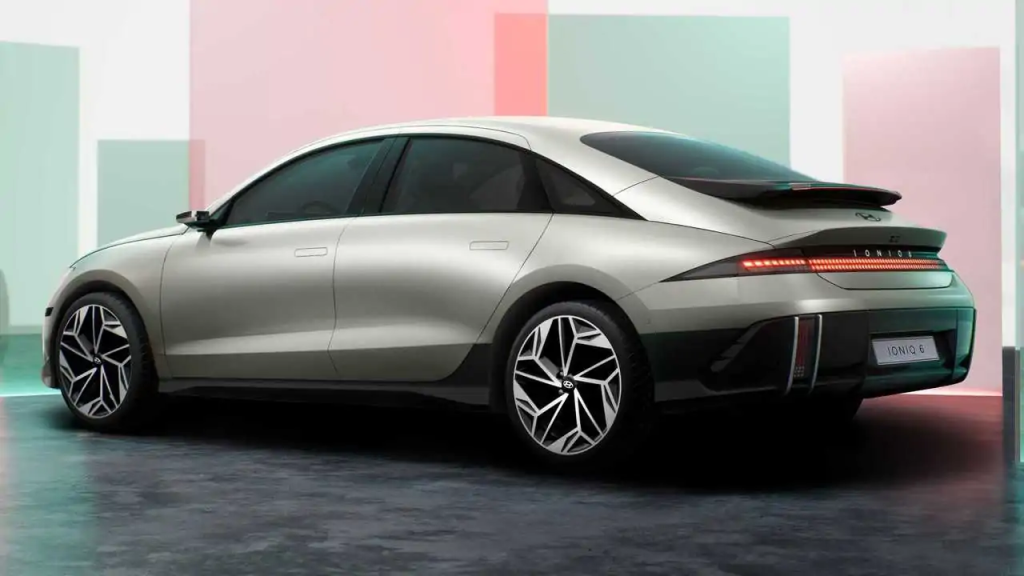
Exploring Vehicle-to-Load Charging with the Hyundai IONIQ 6

Summary- The Hyundai IONIQ 6 is already one of the most award-winning EVs on the market, and its vehicle-to-load charging capability is one of the biggest reasons why. But what exactly is V2L charging, and what can you actually do with it? In this post we break down how bi-directional charging works, the different types available, and all the real world ways the IONIQ 6 can power your home appliances, save you money on electricity bills, and keep you fully equipped on your next camping trip. Table of Contents What Makes the IONIQ 6 So Special? Bi-Directional and Vehicle-to-Load Charging: The Basics Types of Bi-Directional Charging How Many Ways Can You Use V2L Charging with the IONIQ 6? Powering Home Appliances Electricity Savings Camping and Outdoor Use Frequently Asked Questions INTRO What Makes the IONIQ 6 So Special? There are a lot of reasons to love the Hyundai IONIQ 6, and we are not the only ones saying it. Just recently it was recognized by Cars.com as the Best Value EV of 2024. In their statement they highlighted the IONIQ 6's impressive range, tech-forward interior features, and its sheer real world utility — particularly when it comes to bi-directional charging capability. So what exactly is bi-directional and vehicle-to-load charging, and what makes it so incredibly useful in everyday life? Let us take a closer look at how the technology works and what you can actually do with it. BIDIRECTIONAL BASICS Bi-Directional and Vehicle-to-Load Charging: The Basics Until recently, EV charging worked like a one-way street. The battery drains over time as you drive, and you plug it into an appropriate charger when you want to bring it back up to full power. Simple enough. Then engineers at car companies started to realize something important. EV batteries are incredibly powerful. In fact an EV battery can hold up to twice the amount of energy that most households require in a single day. So in theory you should be able to plug your car into any number of home appliances and run them for a decent amount of time. All it takes is an upgrade to the car's onboard software, and just like that a whole new world of possibilities opens up. Bi-directional charging with EVs is still fairly new technology. Most models are not yet equipped for it, but the list is steadily growing as automakers continue to develop and master the tech. Currently both the 2024 Hyundai IONIQ 6 and the IONIQ 5 can be optioned with vehicle-to-load charging capability, making them two of the most versatile EVs on the market today. TYPES OF BIDIRECTIONAL Types of Bi-Directional Charging It is worth noting that bi-directional charging and vehicle-to-load charging are related but they are not totally interchangeable terms. Vehicle-to-load is actually just one specific type of bi-directional charging. Here is a quick breakdown of all the different types and what each one does: Vehicle-to-Load (V2L): The most common and well-known type. It allows you to plug everyday appliances and devices directly into your EV and power them using the car's battery. Vehicle-to-Grid (V2G): This type allows power to flow back into the electrical grid while the car is charging, which helps reduce strain on the grid and improves overall energy efficiency. Vehicle-to-Home (V2H): This type can enable a properly charged EV to power critical home systems, resulting in significant savings on electricity bills and acting as a backup power source when needed. Vehicle-to-Vehicle (V2V): This type of power transfer allows an EV with a full battery to recharge another EV with a dead or low battery, essentially turning your car into a mobile charging station. All of these types of bi-directional charging are related but they differ significantly in the amount of power output they require. V2H and V2V charging tends to draw a lot more power than V2L, which is why many cars that are capable of vehicle-to-load charging are not yet able to fully power a home or boost another EV. V2L APPLICATIONS How Many Ways Can You Use V2L Charging with the IONIQ 6? Even though the IONIQ 6's V2L capabilities cannot power absolutely everything, there is still a surprisingly wide range of practical applications when the car is properly charged. According to Hyundai, using the external charger the IONIQ 6 can power appliances that require up to 16 amps. It also features a built-in interior charger that can be used to power smaller devices directly inside the cabin. HOME APPLIANCES Powering Home Appliances The ability to run home appliances directly off your EV battery is by far one of the coolest and most practical features of V2L charging. If you are not sure why that matters just wait until the next time your power goes out and you will understand immediately. As long as the IONIQ 6 has enough battery charge, you can power multiple lights throughout your home, which means you no longer have to fumble around with flashlights or candles during an outage. You can also keep your phones and tablets charged, and even run your TV for a period of time to stay connected and informed. Perhaps most importantly though, V2L charging can keep your refrigerator running for a significant period of time during a power outage. Most home refrigerators use between 3 and 6 amps, which is well under the 16-amp cap that the IONIQ 6 supports. Keeping your fridge running can save you hundreds of dollars in potentially spoiled groceries, and it also means you can heat food using a microwave rather than being left completely without options. ELECTRICITY SAVINGS Electricity Savings Even when your power has not gone out, there are still smart ways to use V2L charging to save money on your electricity bills. One of the most effective strategies is using your IONIQ 6 to power certain appliances during peak hours when electricity prices are at their highest, effectively letting you avoid those higher rates altogether. Many kitchen appliances as well as modern washing machines and dryers can be run directly off the IONIQ 6's battery. This kind of strategic energy use may become increasingly important as natural gas rates continue to climb and electric bills follow suit. Having an EV that can act as a backup power source gives you a level of energy flexibility that most households simply do not have access to. CAMPING Camping and Outdoor Use The IONIQ 6 may not seem like the obvious choice for a camping trip at first glance, but its V2L capabilities make it an absolutely brilliant companion for anyone who loves getting out into the backcountry and boondocking off the grid. In the old days if you wanted to camp somewhere remote and still have access to electricity, you had no choice but to lug along a noisy and smelly gas-powered generator. Now you can simply plug your camp stove, electric cooler, lights, projector, e-bikes, and more directly into your IONIQ 6 and have enough power to last a couple of days at minimum. No noise, no fumes, no extra fuel to haul around. And as the technology continues to improve and vehicle-to-vehicle charging becomes more commonplace, you will also be able to give other electric vehicles a boost right from your own battery, making the IONIQ 6 one of the most versatile and future-ready EVs on the road today. FINAL CTA The Cars.com Best Value EV award is just one of many accolades the IONIQ 6 has picked up recently. It also holds a perfect 10 out of 10 rating from Car and Driver and a Top Safety Pick+ from the IIHS. If you are ready to experience one of the most capable and well-equipped EVs on the market, McCarthy Olathe Hyundai has you covered. Browse our new electric car specials online or give us a call at (913) 213-0411 to learn more. And be sure to ask us about easy at-home EV charger installation near Overland Park. FAQs Frequently Asked Questions What is vehicle-to-load charging? Vehicle-to-load charging, or V2L, is a type of bi-directional charging that allows you to use your EV's battery to power everyday appliances and devices, from refrigerators and microwaves to camp stoves and e-bikes. Does the 2024 Hyundai IONIQ 6 have bi-directional charging? Yes. The 2024 Hyundai IONIQ 6 can be optioned with vehicle-to-load charging capability, allowing it to power appliances requiring up to 16 amps using its external charger. What appliances can the IONIQ 6 power? The IONIQ 6 can power lights, phones, tablets, televisions, refrigerators, microwaves, washing machines, dryers, camp stoves, electric coolers, projectors, and e-bikes, among many other devices and appliances. Can the IONIQ 6 power my home during a power outage? The IONIQ 6 supports V2L charging which can power individual appliances during an outage. For full home backup power you would need V2H capability, which requires a higher power output than V2L currently supports. Where can I buy a Hyundai IONIQ 6 in Kansas City? You can find the Hyundai IONIQ 6 at McCarthy Olathe Hyundai in Olathe, Kansas. Call us at (913) 213-0411 or browse our current EV specials online today. SCHEMA SCHEMA

Hyubdai recieving award

A Definitive Hyundai Awards Roundup

Summary Hyundai had an outstanding 2023, sweeping awards across every category cars, SUVs, trucks, and EVs. From the Elantra earning top safety honors to the IONIQ 6 being named best EV of the year, Hyundai proved once again why it's one of the most trusted and decorated automakers in the country. Whether you're looking for a family SUV, a fuel-efficient sedan, or a cutting-edge electric vehicle, there's a award-winning Hyundai built for you. Table of Contents Hyundai's Award-Winning Year Awards for Hyundai Cars Hyundai Elantra Awards Hyundai Sonata Awards Awards for Hyundai SUVs and Trucks Hyundai Santa Fe Awards Hyundai Santa Cruz Awards Hyundai Tucson Awards Hyundai Venue Awards Hyundai Palisade Awards Hyundai Kona Awards Awards for Hyundai EVs Hyundai Kona Electric Awards Hyundai IONIQ 5 Awards Hyundai IONIQ 6 Awards Hyundai Brand Awards FAQs A Definitive Hyundai Awards Roundup Hyundai had an outstanding 2023, sweeping awards across every category cars, SUVs, trucks, and EVs. From the Elantra earning top safety honors to the IONIQ 6 being named best EV of the year, Hyundai proved once again why it's one of the most trusted and decorated automakers in the country. Whether you're looking for a family SUV, a fuel-efficient sedan, or a cutting-edge electric vehicle, there's an award-winning Hyundai built for you. Why This Roundup Matters With 2023 now firmly in the rearview mirror, it's the perfect time to look back and appreciate just how much Hyundai accomplished over the past year. From sedans to SUVs, trucks to electric vehicles, the Korean automaker swept awards across nearly every category imaginable. Whether you're already a Hyundai fan or you're still on the fence, this list might just make up your mind. Let's break it all down, one model at a time. HYUNDAI CARS Awards for Hyundai Cars Hyundai first made its mark in America with the Sonata back in the mid-80s, and four decades later, that legacy is still going strong. The Sonata remains a staple in the mid-size sedan segment, while the Elantra has carved out a reputation in the performance world with its N models. Both are available in hybrid versions too, making them smart picks for fuel-conscious buyers. Hyundai Elantra Awards The Hyundai Elantra had a standout year, picking up three major honors that cover efficiency, performance, and safety all at once. 2023 Best Hybrid Car for the Money — U.S. News & World Report 2023 Editor's Choice Sport Compact Car — Car and Driver 2023 Top Safety Pick+ — IIHS Hyundai Sonata Awards The Hyundai Sonata continued proving why it's one of the most respected family sedans on the market, earning recognition for both value and environmental responsibility. 2023 Editor's Choice Family Sedan — Car and Driver 2023 Greenest Vehicles — American Council for an Energy-Efficient Economy 2023 Top Safety Pick — IIHS Awards for Hyundai SUVs and Trucks Around the turn of the century, Hyundai made a serious push into the SUV market — and it paid off in a big way. Today they're recognized as one of the best family vehicle brands in the country, offering everything from the compact Venue to the spacious Palisade, with a wide range of hybrid and plug-in hybrid options throughout the lineup. They even jumped into the small truck game with the fan-favorite Santa Cruz. Hyundai Santa Fe Awards The Hyundai Santa Fe dominated the midsize SUV category this year, earning four separate awards from some of the most respected names in automotive journalism. 2023 Best Buy 2-Row Midsize SUV — Kelley Blue Book 2023 Editor's Choice Midsize SUV — Car and Driver 2023 Best 2-Row SUV for the Money — U.S. News & World Report 2023 Best New SUV for Teens — U.S. News & World Report Hyundai Santa Cruz Awards The Hyundai Santa Cruz continues to win over buyers and critics who want the utility of a truck without the bulk of a full-size pickup. Best Small Pickup — Newsweek Best Urban Pickup — Cars.com 2023 APEAL Award — J.D. Power Hyundai Tucson Awards The Hyundai Tucson earned high marks for both safety and teen-driver friendliness — a combination that makes it a go-to pick for families. 2023 Best New SUV for Teens — U.S. News & World Report 2023 Top Safety Pick+ — IIHS Hyundai Venue Awards Don't let its smaller size fool you — the Hyundai Venue packs serious value into a compact package. 2024 Best Buy Subcompact Crossover — Consumer Guide Hyundai Palisade Awards The Hyundai Palisade is the crown jewel of the Hyundai SUV lineup, and the awards this year reflect exactly that — interior quality, value, and safety all in one package. 2023 Best Interiors and UX — Wards 2023 Best New Cars — Autotrader 2023 Best 3-Row SUV for the Money — U.S. News & World Report Driver's Choice Award — MotorWeek 2023 Top Safety Pick+ — IIHS Hyundai Kona Awards The Hyundai Kona is quickly becoming one of the most decorated subcompact SUVs on the market — and for good reason. 2024 Best Buy Subcompact SUV — Kelley Blue Book 2023 Best Subcompact SUV for the Money — U.S. News & World Report 2023 Best New SUV for Teens — U.S. News & World Report HYUNDAI EVs Awards for Hyundai EVs The electric vehicle market is growing fast, and Hyundai is right at the front of the pack. The IONIQ lineup offers some of the best range and fastest charging speeds available — even compared to high-dollar luxury competitors. And for buyers just getting into EVs, the Kona Electric is a perfect starting point. Hyundai Kona Electric Awards The Hyundai Kona Electric earned recognition as one of the best entry-level electric crossovers on the market. EV of the Year — Hispanic Motor Press Hyundai IONIQ 5 Awards The Hyundai IONIQ 5 is one of the most talked-about EVs on the road right now — and these awards show exactly why. 2024 Best Buy Electric Vehicle — Kelley Blue Book 2024 10Best Trucks and SUVs — Car and Driver #1 Electric Car — The Car Connection 2023 Top Safety Pick+ — IIHS Hyundai IONIQ 6 Awards If the IONIQ 5 is impressive, the Hyundai IONIQ 6 is on another level entirely — especially when it comes to charging speed and efficiency. Best EV of the Year — The Drive #1 Fastest EV Charging — Edmunds 2024 Editor's Choice — EV Pulse 10 Best Engines and Propulsion Systems — Wards Top 10 Family Cars — Fatherly 2023 Top Safety Pick+ — IIHS BRAND AWARDS Hyundai Brand Awards — The Big Picture The recognition doesn't stop at individual models either. Hyundai as a brand earned a nod from the EPA as one of the best overall brands for fuel economy, and J.D. Power recognized them as one of the most tech-forward automakers in the industry. That's a testament to how seriously Hyundai takes innovation across their entire lineup — not just in select models. There's never been a better time to get behind the wheel of a new Hyundai. Come visit your local Olathe Hyundai dealer or call McCarthy Olathe Hyundai at (913) 324-7200 to learn more about our current new vehicle specials. FAQs Frequently Asked Questions Which Hyundai won the most awards in 2023? The Hyundai Palisade and IONIQ 6 both earned five or more awards each, making them the most decorated models of the year across their respective categories. Which Hyundai SUV is the safest? The Hyundai Palisade, Tucson, and Kona all received the IIHS Top Safety Pick+ award — the highest safety rating available from the Insurance Institute for Highway Safety. Is the Hyundai IONIQ 6 a good electric car? Yes — the IONIQ 6 was named Best EV of the Year by The Drive and ranked #1 for fastest EV charging by Edmunds, making it one of the top electric cars available in 2023 and 2024. What is the best Hyundai SUV for families? The Hyundai Palisade is widely considered the best family SUV in the lineup, earning the Best 3-Row SUV for the Money award from U.S. News & World Report along with multiple other honors. Where can I buy an award-winning Hyundai in Kansas City? You can visit McCarthy Olathe Hyundai in Olathe, Kansas or call us at (913) 324-7200 to explore our full lineup and current new vehicle specials. All your real URLs are now plugged in throughout the entire HTML. Just copy and paste the whole thing into a Custom HTML block in WordPress and you're good to go! Sonnet 4.6

 credit score meter showing improvement

6 Tips to Fix Your Credit Score Fast (And Get a Better Car Loan)

Summary- Your credit score controls more of your life than most people realize from the house you can buy, to the interest rate on your next car loan. With nearly 40% of Americans sitting below a "good" credit rating, it's a problem that affects millions of people every day. But here's the thing - it's fixable. In this guide, we walk you through 6 proven tips to improve your credit score quickly and smartly. You'll learn why your payment history is the most critical factor, how to handle collections accounts strategically, and how something as simple as calling your credit card company can instantly lower your utilization rate. We also cover lesser-known tactics like credit piggybacking, credit-builder loans, and disputing errors on your report that could be quietly dragging your score down without you even knowing. Whether you have no credit history, some bumps in the past, or just want to get a better deal on your next auto loan in Kansas City - this guide is your starting point. Table of Contents Why Your Credit Score Matters Tip 1 — Pay Bills on Time Tip 2 — Take Care of Collections Tip 3 — Optimize Your Credit Utilization Tip 4 — Become an Authorized User Tip 5 — Apply for a Credit-Builder Loan Tip 6 — Dispute Errors on Your Report Bonus Tip — Best Auto Loan in Kansas City FAQs Why Your Credit Score Matters More Than You Think Here's the reality in the United States, your credit score is one of the most powerful numbers attached to your name. Around 40% of Americans have credit ranked below "good," and roughly 1 in 5 fall into the "very poor" category. That's a lot of people quietly struggling with something that affects their daily life more than they realize. A low credit score doesn't just make it harder to buy a home. It can push up your utility deposits, limit your housing options, and if you're reading this it can directly impact the interest rate you get on a car loan. The higher your interest rate, the more you pay over the life of the loan. It adds up fast. The good news? Your credit score is not a permanent sentence. It can be improved, and in some cases, it can be improved quickly. Here are 6 tips that actually work. Tip 1 - Pay Bills on Time Let's start with the most important one, even if it sounds obvious. Your payment history is the single biggest factor in determining your credit score. It's not one of the factors - it's the factor. So if you're only going to focus on one thing, make it this. Here's what happens when you miss a payment: if a bill goes unpaid for 30 days, your creditor can report it to the credit bureaus, and your score drops. And that late payment? It can sit on your credit report for up to seven years. That's a long shadow for one missed payment. The fix is simple but requires some discipline. Sit down and list out every single bill you pay each month rent or mortgage, credit cards, subscriptions, utilities, everything. Write down the exact due date for each one. Then, wherever possible, set up automatic payments so you never miss a due date again. Even bills that don't directly report to credit bureaus (like a streaming subscription) can still be sent to collections if ignored long enough and collections are something you really want to avoid. Tip 2 - Take Care of Collections If a bill goes unpaid long enough usually around 90 days. The creditor may hand it off to a collections agency. When that happens, a collections account shows up on your credit report, and it's a serious red flag for any lender looking at your file. A collections account can stay on your report for seven years from the original delinquency date. Here's where it gets a little complicated, though. Not all collections affect your score equally. For example, unpaid medical debt under $500 won't impact your score at all under newer scoring models. And depending on which credit scoring model a lender uses, paying off a collection may or may not immediately help your score. Under FICO Score 8 (the most widely used model today), collections that are paid off still count against you within that seven-year window. Under the newer FICO Score 10, paid-off collections are ignored entirely. As more lenders shift to modern models, paying off collections will increasingly work in your favor. So should you pay them off even if it doesn't instantly boost your score? Yes, absolutely. And here's a little-known perk: collection agencies can negotiate. They often settle for as little as 50% of the original amount, especially if you can pay in a lump sum. Always worth a call. Tip 3 - Optimize Your Credit Utilization Credit utilization is simply the percentage of your available credit that you're currently using. If you have a credit card with a $1,000 limit and a $200 balance, your utilization on that card is 20%. This is the second biggest factor in your credit score, right after payment history. The lower your utilization, the better. Most experts recommend staying under 30%, and people with excellent credit scores often stay in the single digits. The most straightforward way to lower your utilization is to pay down your balances. When doing this, focus on the cards with the highest utilization percentage first, not just the highest dollar amount. There's also a faster trick worth knowing: call your creditor and ask for a credit limit increase. Say you owe $800 on a $1,000 card- that's 80% utilization. If you call and they raise your limit to $2,000, your utilization instantly drops to 40% without you paying a single dollar. It won't work for everyone, but if you're in good standing with your creditor, it's absolutely worth asking. Tip 4 - Become an Authorized User Sometimes the fastest way to build credit is to borrow someone else's good habits and that's completely legitimate. If a trusted friend or family member adds you as an authorized user on their credit card account, their positive payment history on that account can show up on your credit report and boost your score. This is commonly called "credit piggybacking." This strategy works especially well if you have little to no credit history. The risk to the person adding you is very low - they don't have to give you the actual card, and their credit isn't harmed as long as they keep paying on time. Just make sure you're piggybacking off someone with a strong credit history and reliable payment habits. Tip 5 - Apply for a Credit-Builder Loan If you're starting from scratch or trying to rebuild after some rough patches, a credit-builder loan is one of the best tools available to you. Unlike a regular loan, you don't receive the money upfront. Instead, the lender holds the loan amount in an account while you make regular monthly payments. Once the loan is fully paid off, you receive the total amount kind of like a forced savings plan with a credit-building bonus. Every on-time payment gets reported to the credit bureaus, which steadily builds your score over time. These loans don't require good credit to qualify, which is exactly what makes them so useful for people who are just getting started or starting over. If you already have a well-established credit history, a credit-builder loan won't move the needle much but for anyone building from the ground up, it's a smart move. Tip 6 - Dispute Errors on Your Report This one surprises a lot of people, but credit report errors are more common than you'd think. Mistakes happen payments incorrectly marked as late, outdated information still sitting on your file, or in some cases, signs of identity theft. None of these should be dragging your score down, and the law is on your side to get them removed. Start by pulling your free credit report from AnnualCreditReport.com (the only federally authorized free report site). Review it carefully. If you spot anything that looks wrong, you have two options: dispute it directly with the company that submitted the item, or go straight to the three major credit bureaus Experian, Equifax, and TransUnion. Once you file a dispute, the bureau has 30 days to investigate. If they find the information is incorrect, they're legally required to remove it from your report at no cost to you. Yes, it takes a little time and patience. But given that some items can stay on your report for up to 10 years, finding even one error can make a meaningful difference. Bonus Tip — Get the Best Auto Loan in Kansas City No matter where your credit stands right now, McCarthy Auto works with buyers across the full credit spectrum. Whether you have great credit, fair credit, or you're still working on it and we can help you find a loan that makes sense for your situation. Apply for your auto loan online today → It only takes a few minutes, and you can browse our used vehicle specials while you're at it. SCHEMA MARKUP ARTICLE SCHEMA

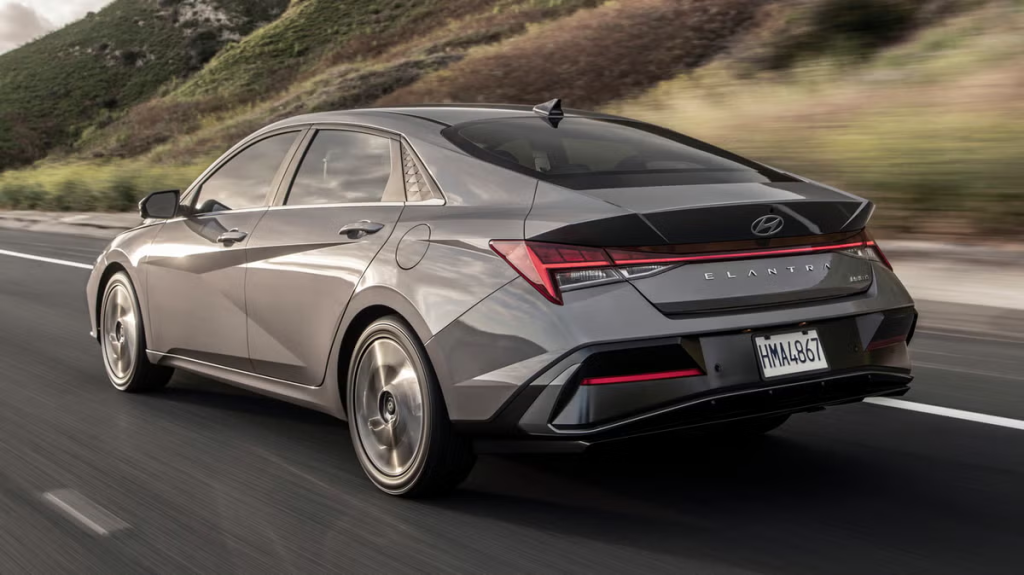
McCarthy Hyundai 2025 Elantra

Hyundai Elantra vs. Toyota Corolla: Which is Better?

Many Kansas City drivers tend to lean towards compact sedans. No two models have gotten more attention over the years than the Hyundai Elantra and Toyota Corolla. Shoppers endlessly try to compare the two models, searching page after page to get all the necessary info to make an informed decision. But no more. In this Hyundai Elantra vs. Toyota Corolla comparison, we’ll look at what makes each machine tick, what features they offer drivers, and much more. Whether you’re ready to purchase a new vehicle or are looking forward to the future, keep reading to find out which of these industry titans takes the cake in this head-to-head. If you’re shopping for a compact sedan near Olathe, Overland Park, Lenexa, or Kansas City, two models likely at the top of your list are the 2025 Hyundai Elantra and the 2025 Toyota Corolla. At McCarthy Hyundai of Olathe, we help drivers compare features, performance, fuel economy, and value so they can confidently choose the right sedan for their lifestyle. Hyundai Elantra vs. Toyota Corolla: Specs To start, both the Hyundai Elantra and Toyota Corolla use 2.0L, four-cylinder engines under the hood of every gas-powered vehicle. The Elantra’s horsepower clocks in at 147, while the Corolla’s clocks in at 169. While the Corolla may have a few more ponies to boast about, that isn’t the end of the story. Hyundai Elantra vs. Toyota Corolla: MPG Let’s talk fuel efficiency. The 2025 Corolla gets 32 MPG city and 41 MPG highway under the best conditions. By comparison, the Elantra delivers 33 MPG in the city and 43 MPG on the highway. So, while the Corolla has a bit more power, the Elantra saves you trips to the gas station over time. In these times, a few dollars at the pump adds up quickly over the years. Hyundai Elantra vs. Toyota Corolla: Size While both vehicles are similarly sized at first glance, seating up to five passengers, the Hyundai Elantra is much roomier and offers a bit more cargo space than the Toyota Corolla can provide. Let’s look at the numbers: 2025 Hyundai Elantra passenger volume: 99.4 cubic feet 2025 Hyundai Elantra cargo space: 14.2 cubic feet 2025 Toyota Corolla passenger volume: 88.6 cubic feet 2025 Toyota Corolla cargo space: 13.1 cubic feet If you want a little extra space to lounge, the Elantra is the right choice. Hyundai Elantra vs. Toyota Corolla: Interior and Technology Both vehicles come standard with cloth seats and manual adjustments for the front. The Elantra has available leather seating, while the Corolla offers SofTex, their proprietary synthetic leather upholstery. The Elantra offers heated and ventilated front seats, while the Corolla only has heated. Both offer 8” touchscreen infotainment systems with wireless Apple CarPlay® and Android Auto™. Both also offer larger 10.25” screens. At the entry level, these vehicles are neck-and-neck, but with what’s available, we think you can see which one comes out on top. Hyundai Elantra vs. Toyota Corolla: Safety Unsurprisingly, both the Elantra and Corolla received five-star ratings from the NHTSA (National Highway Traffic Safety Administration). Lane assist, driver warnings, and more are standard on both vehicles. This category is clearly a tie. Hyundai Elantra vs. Toyota Corolla: Price So, we’ve seen what each vehicle offers. But what do they cost? Let’s look: 2025 Hyundai Elantra: $22,125 2025 Toyota Corolla: $22,325 So, the Elantra offers more room and (relatively) comparative power, AND comes in under the cost of the Corolla. Seems like a no-brainer, right? Test Drive a 2025 Hyundai Elantra in Kansas City Still not sure why the 2025 Hyundai Elantra is the crown royal of sedans? Head down to McCarthy Olathe Hyundai to get behind the wheel and experience the ride for yourself. Contact us today to get started or schedule a test drive online. Drivers across Olathe, Shawnee, Gardner, and the greater Kansas City metro choose McCarthy Hyundai of Olathe for competitive pricing, Hyundai specials, and a wide selection of new Hyundai sedans. If you’re ready to upgrade to a fuel-efficient and tech-forward compact car, our team is here to help. Frequently Asked Questions About Elantra vs Corolla 1. Which is more fuel efficient, the Hyundai Elantra or Toyota Corolla? The 2025 Hyundai Elantra offers slightly better fuel economy, delivering up to 33 MPG city and 43 MPG highway compared to the Corolla’s 32 city and 41 highway MPG. 2. Which sedan has more interior space? The Hyundai Elantra provides more passenger and cargo space than the Toyota Corolla, offering greater comfort for daily commuting and road trips. 3. Is the Hyundai Elantra cheaper than the Toyota Corolla? Yes. The 2025 Hyundai Elantra starts at a lower MSRP than the 2025 Toyota Corolla, while offering competitive features and space. 4. Do both vehicles offer Apple CarPlay and Android Auto? Yes. Both the Hyundai Elantra and Toyota Corolla offer wireless Apple CarPlay and Android Auto compatibility. 5. Where can I test drive a Hyundai Elantra near Kansas City? You can test drive the 2025 Hyundai Elantra at McCarthy Hyundai of Olathe, located at 683 North Rawhide Drive in Olathe, KS.

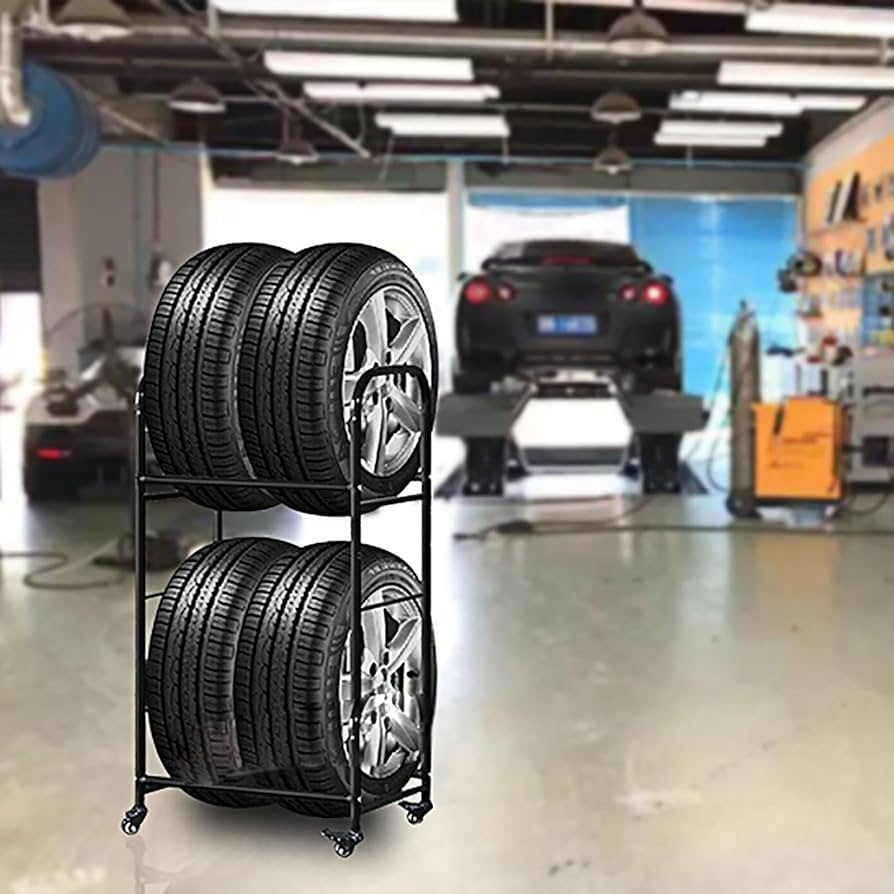
A Quick-and-Simple Car Tire FAQ

There seems to be a lot of confusion out there regarding tires, which is a little bit surprising, considering how important they are. We think basic automotive care should be part of the high school curriculum, and if it were, you could spend a full month on tires alone. Unfortunately, they don’t really teach tire basics in school. Fortunately, you have us to help you out. We combed the internet and our service center voicemail, and found some of your most burning tire-related questions. Now, let’s see if we can provide some answers. Tire Measurements Have you ever noticed all the numbers and letters imprinted into the rubber on the side of your tire? These are your tire measurements and specifications and understanding them is crucial when the time comes to choose the right tire to fit your vehicle’s rim. Factory tire and rim measurements can be found in your owner’s manual, or in the doorjamb sticker on the driver’s door. As an example, we’ll take a common measurement you’d find on a tire for a 2022 Hyundai Sonata SE: P205/65R16 95H Or, P 205 65 R 16 95 H Vehicle Class P. This optional digit indicates the type of vehicle the car is rated for—in this case, “P” stands for “passenger vehicle.” Many top tire brands will not have this digit. (Note: larger SUVs and trucks may fall under the “LT” or “light truck” class, and will have a slightly different measurement system.) Width 205. These digits show the tire’s overall width in millimeters. Aspect Ratio 65. These digits represent the sidewall height, expressed as a percentage of the width (i.e. the sidewall height is 65% of the overall width). Construction R. This letter shows the overall tire design. Almost all passenger cars have the designation “R,” which means “radial.” Rim Diameter 16. This number is the rim size that fits the tire. In this case, the rim is 16 inches. Load Index 95. This number is a representation of the maximum weight the tire is rated for. In this case, the number 95 translates to just over 1,500 pounds. Speed Rating H. This letter represents the speed at which the tire can safely travel under normal conditions. “H” translates to 130 miles per hour. Other Measurements There are a few other codes imprinted on most consumer tires. Tires are required to have a maximum inflation pressure; however, you should not inflate the tire to this level. Instead, use the optimal PSI laid out in the owner’s manual. Uniform Tire Quality Grading (UTQG) can also be found, expressed as three values: treadwear, traction, and temperature. These measurements give you a rough idea of the optimal conditions for the specific tire type. Common Types of Tires Now that you know how to read your tire, we can check out the different types, and how they differ. All-Season Tires As the name suggests, all-season tires are meant to provide traction and stability in a wide range of conditions. They’re the most common type of tire you can think of them as the “jack of all trades,” and they’re often recognized as some of the best tire brands for people in milder climates. While they do well in a variety of situations, their performance tends to suffer in extreme weather like heavy rain or snow. They also aren’t optimized for frequent high speeds and may wear out faster if they’re frequently driven on the highway. All-Weather Tires Some people think that all-weather tires and all-season tires are interchangeable terms. Despite the similar name, they do differ slightly. All-weather tires are generally made of slightly tougher stuff than all-season tires, and their tread patterns make them better suited to deal with moderately bad weather like snowfall and excessive rain. Because of their increased utility, these are sometimes seen as the true best tires for all seasons. Summer Tires The difference between all-season and summer tires is that summer tires boast better wet and dry traction in warmer climates, which grants better performance. However, their performance suffers noticeably in snowy and icy conditions, which makes them ill-suited to colder parts of the world. Winter Tires The difference between winter and summer tires is probably obvious: winter tires do a much better job of maintaining traction in snow and ice. They’re great for people who live in high latitudes and mountainous regions, but their performance suffers under warm weather driving conditions. In some locales, it’s common to keep a set of snow tires as backup. If you have a set, you should switch to winter tires when the average temperature dips below 45 degrees Fahrenheit. Touring Tires These tires are maximized for long-distance travel, and as such they’re made of stronger material, and the tread is optimized to provide a smooth ride with minimal road noise and rumbling. Grand touring tires also exist, and while these terms are sometimes used to describe the same thing, GT tires trend toward an even smoother ride. Performance Tires Performance and high-performance tires are designed to provide the best max speed rating, while also enabling the best handling. Many of these tires sport a more lateral tread pattern, meaning the tread goes “side-to-side,” or against the grain. There are multiple subcategories, including all-season performance tires and summer performance tires. Generally speaking, performance tires don’t do very well in inclement weather. Tire Service and Maintenance Now that we’ve covered the basics, let’s get into the nitty-gritty of proper tire maintenance with some frequently asked questions. How Often Should I Replace My Car Tires? All tires come with an approximate mileage that given tire is expected to last. In practice, the lifespan of a tire can vary wildly depending on your driving habits. There are a few ways to know when to replace the tires. You can measure the tread depth at home, either using a special measuring tool or, in a pinch, you can use a penny. A new tire will have a tread depth of approximately 10/32 of an inch, and it’ll need to be replaced when it reaches 2/32 of an inch. If you stick a penny into the center tread, look at Abe’s head; if the tread doesn’t rise above the top of his head from the edge of the coin, it’s time for a replacement. You can also check the tread wear indicators, which are small, hard bumps located at various points inside the central tread groove. If the rubber has worn down to be level with the bump, you’re due for a new set. Should I Replace All Four Tires? It depends. If you just bought new tires in the past few thousand miles, they’re still relatively new. So, if you catch a nail in the sidewall or hit a pothole and have a blowout, you’ll likely be able to get away with buying a similar replacement tire. Even if they’re slightly older, you should be able to compensate for the uneven wear with regular rotations (more on that in a second). On the other hand, if all your tires are old and you find you need to replace one, you might as well go ahead and replace them all. It may be more money up front, but if your tires are getting to the end of their lifespan and one blows out, it’s only a matter of time before the rest follow suit. This presents a dangerous situation for you and others, so changing all four is the best way to go. You can also get some pretty significant discounts by purchasing a whole set from a tire department, as opposed to buying them piecemeal. Are Tire Rotations Necessary? Absolutely. Some people believe that a tire rotation is just another way for mechanics to nickel and dime them. In truth, having your tires properly rotated can prolong their lifespan, and save you gobs of money in the long run. Broadly speaking, the front tires of a vehicle will wear out faster than the rear tires. This happens for a couple of reasons mostly, it’s because of the extra stress that’s put on the front tires when a turn is executed. There are a couple other factors as well, including the drivetrain (tires on a 2WD vehicle will wear a bit differently than a vehicle with AWD or 4WD). Regardless, you should absolutely have your tires rotated about every 10,000 miles, or every other oil change. What Is the Correct Tire Pressure for My Car? As we mentioned briefly a minute ago, passenger vehicle tires usually have a “max inflation pressure” rating, but this number is basically just the absolute most the tires can handle before they explode. Running max pressure for an extended period of time isn’t good for the tires. Instead, you should keep the tires at the pressure noted in the vehicle owner’s manual, or the sticker on the doorjamb. The ideal pressure range is commonly somewhere between 30 and 35 PSI. Modern vehicles also have internal tire pressure sensors, which will alert drivers if pressure is too high or low. Low tire pressure can be detrimental as well, even if the tire isn’t visibly deflated. Low pressure increases the likelihood of blowouts due to bumps and potholes. If left unattended, long-term low pressure will also cause uneven tire wear, which severely reduces the tire’s lifespan and will cost you way more money over time. Are Nitrogen Tires Better? The subject of N2 tires has become a battleground over the years. Nitrogen fans say that it prolongs tire life, increases gas mileage, and stabilizes pressure, while detractors say the difference is negligible and they aren’t worth the extra cost. NHTSA found that nitrogen does indeed escape tires more slowly, largely due to the fact that nitrogen molecules are larger, and therefore don’t escape as easily. It also reduced pressure fluctuations from changing temperature or elevation, and nitrogen does not cause oxidation (read: rust) as quickly as O2. So, the general consensus is all other things being equal filling your tires with a higher nitrogen mixture can indeed prove better for your tires. Many critics are quick to note that the difference isn’t necessarily as noticeable for many drivers, though. Squeezing out an extra mile per gallon or two may not be a priority for people who don’t drive much. Drastic temperature and elevation fluctuations may not apply to you, depending on where you live. And, of course, there’s the question of convenience and price. Refilling tires with nitrogen usually requires a visit to an automotive technician’s shop, and costs more money than filling up with regular air, which can be done at nearly any corner gas station or convenience store. So, while there’s no cut-and-dry answer, it can absolutely be worth it to fill your tires with nitrogen—but the most important thing will always be to make sure you regularly monitor your tire pressure, regardless of what you’re filling them up with. Any Other Questions? Give us a call at (913) 324-7200 and ask for the service department to speak to one of our certified technicians about all your tire-related questions. If you’re looking for a tire shop in Kansas City, our dealership is the place to go for Hyundai models.

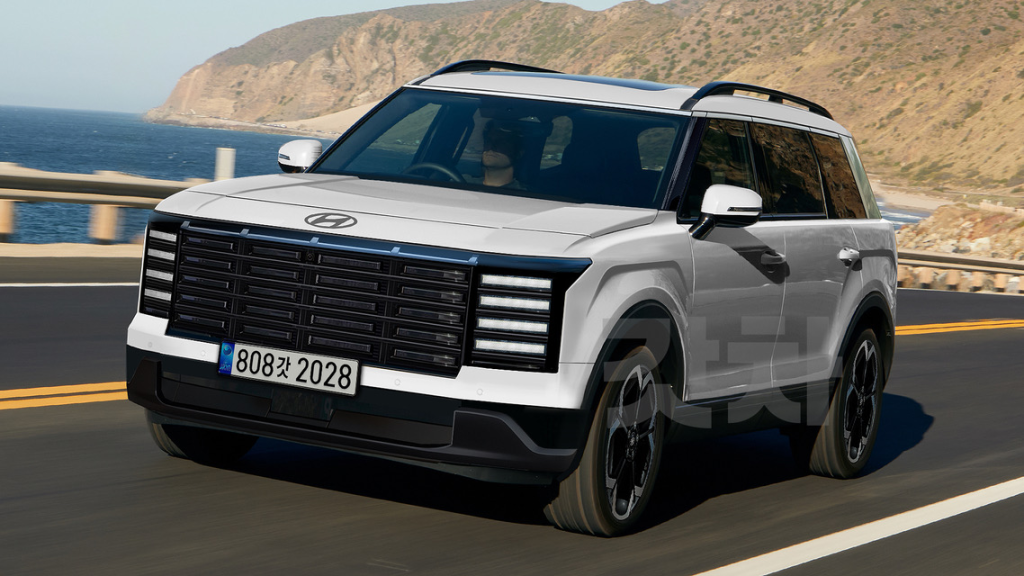
2026 palisade redesign at McCarthy.

2026 Hyundai Palisade Redesign

The Hyundai Palisade is an SUV that gets slept on for how valuable it is. It’s spacious, capable, powerful, and most of all, comfortable. With the 2026 version, there’s even more to love than the previous generation. The Hyundai Palisade redesign tightens things up a bit, making it a more appealing vehicle. What exactly makes the 2026 Hyundai Palisade so enticing? There’s plenty to enjoy with the redesign, but that isn’t quite enough. In this Hyundai Palisade redesign overview, we’ll look at what makes the 2026 Palisade special and why it should be at the top of your list for new Hyundai vehicles to consider. If you’ve been thinking of getting the new Palisade, read on. 2026 Hyundai Palisade Redesign: Specs The 2026 Hyundai Palisade features a 3.5L, V-6 engine, which is a slight decrease from the previous gen’s 3.8L engine. However, it’s tuned to deliver nearly the same specs and MPG. The fuel efficiency stays the same at roughly 19 city MPG and 24-25 MPG highway, though these numbers are much higher for the new Hyundai Palisade Hybrid, which gets 34 MPG combined. While we’re trained to think bigger is better, Hyundai found a way to make a slightly smaller engine perform darn near the same as the previous gen. When you take into consideration that the 2026 Hyundai Palisade is a bit larger overall than the 2025 version, the specs are all the more impressive. Usually, larger vehicles don’t perform as well as the smaller ones, but this Palisade redesign adds more space without sacrificing performance. One pleasant carryover is the choice between front-wheel drive or all-wheel drive, so if you’re a fan of off-road excursions, the 2026 Palisade delivers. 2026 Hyundai Palisade Redesign: Interior and Tech A big difference, that we mentioned, is the increase in size. The 2025 Palisade could only fit up to eight passengers, but the 2026 Hyundai Palisade can now fit up to nine passengers with the right configuration. Both vehicles feature luxury materials and trimmings, but the 2026 takes things a step further with an updated dash, larger infotainment system, and a steering column that adds some much-appreciated space. Overall, the material quality in the 2026 Palisade is much nicer, and the legroom for the second and third rows is a bit more spacious. If you have friends in tow or are bringing the whole family along, these extra few cubic inches are a welcome addition. The first and second rows now feature “relaxation” seating for better leg support, adding to the comfort of additional passengers. When it comes to tech, the 2026 Palisade improves on the 2025 model by having a larger, curved infotainment system that houses dual 12.3” digital screens: one for the driver gauges and one for the infotainment system. Wireless Apple CarPlay® and Android Auto™, a Wi-Fi hotspot, and on-board navigation all come available. There are plenty of USB ports throughout the cabin to keep everyone and their phones or iPads connected, and a premium audio system is an option if you want to upgrade your playlist experience. 2026 Hyundai Palisade Redesign: Safety The 2026 Hyundai Palisade hasn’t been officially crash tested as of this writing; however, it’s expected to perform as well as the 2025 model. The 2025 Hyundai Palisade received a five-star rating from the National Highway Traffic Safety Administration (NHTSA) and a Top Safety Pick from the Insurance Institute for Highway Safety (IIHS), so you’re going to be protected. With the 2026 Palisade, you’ll have: Forward collision avoidance Lane assist Blind-pot collision warnings Available surround view monitoring And more 2026 Hyundai Palisade Redesign: Price For all of these exceptional advantages, the 2026 Hyundai Palisade delivers affordability to keep more money in your wallet. The 2026 Palisade starts at $39,435 MSRP for the entry-level trim and starts at $54,560 MSRP for the fully-loaded Calligraphy trim. There are four trims between these two, so there’s a 2026 Palisade for every need and budget. So be sure to ask our McCarthy Olathe Hyundai team about them to find the right fit for you. Test Drive the 2026 Hyundai Palisade Today Excited about the 2026 Hyundai Palisade redesign? We sure are, and we’re ready and waiting to show you everything it has to offer. If you’re ready to see what the 2026 Palisade can offer you, head down to our Hyundai dealership and explore our selection of new Hyundai vehicles to find the right fit for your needs and budget. Get started by contacting us to schedule a test drive. The Hyundai Palisade is an SUV that gets slept on for how valuable it is. It’s spacious, capable, powerful, and most of all, comfortable. With the 2026 version, there’s even more to love than the previous generation. Frequently Asked Questions About the 2026 Hyundai Palisade 1. What is new in the 2026 Hyundai Palisade redesign? The 2026 Palisade features a slightly smaller but efficient 3.5L V6 engine, expanded seating for up to nine passengers, upgraded interior materials, dual 12.3-inch digital displays, and improved cabin space. 2. Does the 2026 Hyundai Palisade offer a hybrid option? Yes. The 2026 Hyundai Palisade Hybrid delivers an estimated 34 MPG combined, offering improved fuel efficiency for families. 3. How much can the 2026 Hyundai Palisade tow? When properly equipped, the 2026 Palisade can tow up to 5,000 pounds, making it ideal for trailers and camping gear. 4. Is the 2026 Hyundai Palisade available with AWD? Yes. The 2026 Palisade offers available all-wheel drive across most trims for improved traction and capability. 5. Where can I test drive the 2026 Hyundai Palisade near Kansas City? You can test drive the redesigned 2026 Hyundai Palisade at McCarthy Hyundai of Olathe, located at 683 North Rawhide Drive in Olathe, KS.

Unveiling the 2024 Hyundai Kona

Don’t you just love a nice, shiny, all-new vehicle? We sure do, which is why we’re over-the-moon to talk about Hyundai’s latest: the redesigned Kona. At their bombastic presentation at the New York International Auto Show, the Korean automotive wizards announced a whole bunch of juicy new details about the Kona that’s going to be available stateside this year. Let’s cover some of the exciting news but first, a quick trip down memory lane… The Hyundai Kona Through the Years Since its grand US market debut in early 2018, the Kona has consistently established itself among the best-received vehicles in Hyundai’s lineup. Actually, scratch that; it’s one of the best-received SUVs in the entire car industry. Check out some of the awards it’s won since its introduction: 2023 Best Subcompact SUV for the Money— US News 2022 Best Subcompact SUV for the Money— US News 2021 Best Buy Electric Vehicle— Kelley Blue Book 2021 Editor’s Choice, Subcompact SUV— Car and Driver 2020 Best Buy, Subcompact Crossover— Consumer Guide 2020 Top 10 Best Cars for Recent College Graduates— Autotrader 2020 Vehicle Satisfaction Awards, Subcompact Crossover SUV— AutoPacific 2019 Best Economic Performance, Mini Crossovers— Automotive Science Group 2019 North American Utility Vehicle of the Year— NACTOY We cherry-picked that list, by the way. Those were just the ones we had room for. With such an illustrious track record, how will Hyundai keep the momentum for the all-new second generation 2024 Hyundai Kona? An EV-First Approach Most newly-hatched vehicles start out with a traditional gasoline engine schematic, with any electrified powertrain options implemented afterward. Hyundai’s decided to flip this trend on its head—from the beginning, the 2024 Kona was designed as an EV first and foremost. Bucking the conventional design approach allowed the new Kona to take on a unique exterior style, crafted to be elegantly aerodynamic for the best possible efficiency. From the get-go, the sharp frontal profile is instantly recognizable the classic EV “frunk” storage is included, and the conventional radiator grille has been replaced by the Seamless Horizon daytime running light. The 2024 Kona EV motor puts out 150kW, and Hyundai’s preliminary tests indicate an estimated 260 miles of electric range. With proper infrastructure, the battery is expected to charge from 10 to 80% in under 45 minutes. One-pedal driving with i-PEDAL makes use of the Smart Regenerative System to bolster driving range, and regenerative braking will improve range even further when adaptive cruise control is active. A Selection of Gasoline Engines and Drivetrains For those not quite ready to make the leap to full-electric, two gas-powered models of 2024 Kona will be available at launch: the internal combustion engine (ICE) Kona, and the Kona N-Line. The souped-up N-Line houses a 1.6L turbocharged inline 4-cylinder. It’s predicted to haul out with 190 horsies and 195 lb.-ft. of torque, for those who prefer a more nimble and responsive driving experience from their family SUV. It’ll also have an 8-speed automatic transmission, an upgrade from the previous 7-speed. The boosted N-Line package also includes 19-inch wheels and trim-exclusive body flair. Meanwhile, the meat-and-potatoes Kona model boasts a 2.0-liter 4-cylinder motor, which reportedly produces about 147 horsepower and 132 lb.-ft. of torque. Two-wheel drive is said to be standard, but HTRAC all-wheel drive models will be available as well, complete with higher ground clearance for drivers with a sense of adventure. Currently, although the new Kona definitely has all the substructure in place to support it, no hybrid or PHEV powertrain has been confirmed… yet. Likewise, no word has been released on a performance-geared 2024 Hyundai Kona N (the N and N-Line designations are different slightly confusing, we know). Considering the fact that the 2021 Kona was the first ever performance SUV engineered for the Hyundai N division, it seems possible that we’ll get one eventually. We can dream! A Big, Bold New Interior If you’ve heard anything about the all-new Kona yet, chances are you’ve heard that it’s gotten bigger— way bigger. The ICE model of Kona 2024 has gained almost 6 inches of total length since the last generation, as well as a noticeable increase in width and wheelbase. So, what’s Hyundai done with all that extra space? The Kona models of yesteryear won plenty of accolades, but some critics noted that it didn’t exactly have the biggest allotment of cargo space. The 2023 Kona SE, for instance, showed off 19.2 cubic feet of cargo volume with the seats up decent numbers for a subcompact SUV, but not blow-your-socks-off spacious. Hyundai heard the message loud and clear, and redesigned the 2024 Kona with over 6 more cu. ft. in the back, bringing it up to about 25-and-a-half total cubes that’s a size increase of 33%! If that wasn’t enough, when the rear seats are folded, the cargo volume of the new Kona is reported to be almost 64 cubic feet. Passenger space has been upgraded in a big way, too. The Hyundai masterminds designed the 2024 Kona as a “living space,” prioritizing comfort ergonomics to make it one of the best new family SUVs of the year. The seats have been designed to be slimmer, adding extra rear legroom for passengers and giving the cabin a much more open vibe. Seats also have a full recline mode, allowing for max relaxation on long drives and pit stops. Other sophisticated interior features include storage spaces accented with mood lighting that shifts according to drive mode, and a versatile open center console concept with rotational cupholders. The cabin has also been optimized for the quietest ride possible, eliminating road noise in accordance with the Kona’s EV-centric design. An Emphasis on Tech The infotainment system in the new Hyundai Kona rivals the brand’s Genesis nameplate in style and function it consists of two 12.3-inch widescreen digital displays, positioned side-by-side. They combine to create a customizable UI that displays safety features, vehicle diagnostics, media, navigation, and more. Other stellar infotainment features include Wi-Fi hotspot capability, and an available 8-speaker Bose stereo with subwoofer, which will provide an unparalleled listening experience thanks to the quiet cabin engineering. Over-the-Air software updates will ensure that the Kona is always working with the latest and greatest interfacing and processing power. With a focus on the future, Hyundai has added Digital Key 2, the second iteration of their touchless security system. With SK2, you don’t even need the keys to operate your Hyundai Kona—you can lock and unlock, start the engine, and even share keys with approved family members through your smartphone or smartwatch. A Focus on Safety Hyundai has always made their safety and driver assistance packages a major priority, and they continue to do so in the 2024 model year. We’ll have to wait a while longer on the official crash test scores, but here’s what we do know: the next step in Hyundai SmartSense is here, and it includes many features not available in other subcompact SUVs. Using a series of exterior cameras and sensors, Blind-Spot and Surround-View Monitoring are available, allowing drivers to confidently navigate everything from interstate merges to cramped parking lots. Long road trips with the family are a breeze with Highway Driving Assist, which works in tandem with other features like Navigation-Based Smart Cruise Control, Intelligent Speed Limit Assist, High Beam Assist, and Driver Attention Warning all designed to help travel the open road with the utmost ease. SmartSense protects drivers and passengers in the city as well, with available Remote Smart Parking Assist, Parking Collision Avoidance/Reverse, Forward Collision-Avoidance Assist, Rear Cross-Traffic Collision-Avoidance, and Rear Occupant Alert with Safe Exit Warning. Nervous parallel parkers, rejoice! Ready to Join the Next Generation? If you’re thinking of holding out for the EV, ask your local dealer about Hyundai Home and the Hyundai Evolve+ app. With these new services, Hyundai is making it easier than ever to electrify your home, and for the EV-curious, they also offer a subscription platform for you and the whole family to test out a Hyundai EV, totally loan-free! The Kona EV is slated to hit dealerships in late fall, but if you just can’t wait for a new SUV, the gas-powered 2024 Kona will be ready to roll by summertime. If you want to learn how to preorder your own, contact your local Hyundai dealership in Olathe by dialing (913) 324-7200 chat with one of our friendly team members, and discover for yourself why the Hyundai Motor Group is now the 3 rd largest auto company in the world! Frequently Asked Questions About the 2024 Hyundai Kona 1. What is the electric range of the 2024 Hyundai Kona EV? The 2024 Hyundai Kona EV is expected to deliver an estimated 260 miles of range on a full charge, depending on driving conditions. 2. How much cargo space does the 2024 Hyundai Kona have? The redesigned Kona offers approximately 25.5 cubic feet of cargo space behind the rear seats and nearly 64 cubic feet with the seats folded. 3. Is the 2024 Hyundai Kona available with AWD? Yes. Gas-powered Kona models offer available HTRAC all-wheel drive for improved traction and versatility. 4. Does the 2024 Hyundai Kona support wireless Apple CarPlay and Android Auto? Yes. The 2024 Kona includes advanced infotainment with large digital displays and smartphone integration compatibility. 5. Where can I test drive a 2024 Hyundai Kona near Kansas City? You can test drive the 2024 Hyundai Kona at McCarthy Hyundai of Olath e, located at 681 North Rawhide Drive in Olathe, KS.

Top 3 Hyundai Cars & SUVs for Families

When you are shopping for a new family vehicle, there are a number of factors to consider in order to find the right choice. You need enough power to handle highways around Kansas City, tech and comfort so everyone can relax on rides, and safety features to keep everyone protected. Fortunately, Hyundai makes some of the best cars for families on the market today. In this roundup, we’ll look at the best cars for families and examine three different sizes of vehicles and what makes them stand out from the competition. Read on to learn why Hyundais are great cars for parents. If you’re shopping for a reliable family vehicle near Olathe, Overland Park, Lenexa, or Kansas City, Hyundai offers some of the safest and most versatile options on the road today. At McCarthy Hyundai of Olathe, we help families compare sedans and SUVs to find the perfect combination of space, comfort, safety, and value. Here are three of the best Hyundai vehicles for families in 2025. Best Car for Families: Hyundai Sonata For fans of sedans, there are few that compete with the value delivered by the Hyundai Sonata, especially when it comes to getting your family around town. Ideal for smaller or starting families, the Sonata seats up to five and has a solid amount of cargo space to pack essentials. The trunk offers 15.6 cubic feet of storage, while the interior delivers 104.4 cubic feet of passenger volume. The Hyundai Sonata comes standard with a 2.5L 4-cylinder engine worth 192 horsepower, more than enough to tackle the highways; additionally, other Hyundai Sonata trims offer more powerful engines, if that’s your thing. Front-wheel drive is standard, though some trims have available all-wheel drive for improved handling. The standard infotainment system is a 12.3” touchscreen, though higher trims have navigation built in. Android Auto™ and Apple CarPlay® come standard across all trims, and dynamic voice recognition is available. Where the Sonata really shines is in its safety features, though. It received a 5-star rating from the Insurance Institute for Highway Safety, and comes equipped with a host of driver assistance features, including: Forward collision avoidance assist Lane keeping assist Lane following assist Driver attention warning Available highway driving assist Available surround view monitor And more Best Compact SUV for Families: Hyundai Tucson Next up is the Hyundai Tucson. While it seats five, due to its SUV style, it offers a bit more room for passengers and much more cargo space, especially with the rear seats folded down. The total passenger volume clocks in at 108.2 cubic feet, and the max cargo space is a whopping 80.3 cubic feet. All Hyundai Tucson trims share the same engine, a 2.5L 4-cylinder that makes 187 horsepower. While a little less than the Sonata, it still offers plenty of pep, with slightly more fun when it comes to handling. You’ll also have a choice between FWD or AWD, depending on the trim. Heated front seats are available, but heated rear seats are only available on the highest trim, the Hyundai Tucson Limited. The infotainment system is the same as the Sonata, a 12.3” touchscreen with available built-in navigation, as well as Android Auto™ and Apple CarPlay® compatibility. Once again, safety reigns in a Hyundai, thanks to the SmartSense suite, with features including: Blind-spot collision warning Available blind-spot monitoring Lane assist Available highway driving assist Smart cruise control Safe exit warning And more Best Midsize SUV for Families: Hyundai Palisade For larger families or for those who want the most room for stretching out, the Hyundai Palisade is the top choice. This 3-row behemoth seats up to eight, so if your family is growing, it’s perfect. The standard Palisade comes with a 3.5L V-6 engine with 287 horsepower; the Hyundai Palisade Hybrid comes with a setup that nets a powerful 329 horsepower. With available AWD, if you and your family like heading off-road, the Palisade is more than capable of getting you to your next camping trip home base. If you need additional comfort, you can opt for the available heated second and third rows. All Hyundai Palisade trims, like the Sonata and Tucson, come with a 12.3” infotainment system; higher trims get onboard navigation and traffic flow updates. Apple CarPlay® and Android Auto™ are standard, though upper-level trims get an intercom system to speak to passengers in the back without needing to yell. We once again see a five-star rating from the IIHS for the Palisade, with safety features including: Intelligent speed limit assist Blind-spot collision warning Rear cross-traffic avoidance assist Lane following assist Lane keeping assist Highway driving assist Available surround view monitor Navigation-based smart cruise control And more Test Drive a New Hyundai Today Ready to pick the best car or SUV for your family? Look no further than McCarthy Olathe Hyundai. Head down to our showroom to explore our full lineup of new and pre-owned Hyundai vehicles to find the perfect fit for your family. Contact us today to learn more or to schedule a test drive! Families throughout Olathe, Shawnee, Gardner, and the greater Kansas City metro trust McCarthy Hyundai of Olathe for competitive pricing, Hyundai specials, and a stress-free buying experience. Whether you prefer a sedan like the Sonata or a spacious SUV like the Tucson or Palisade, our team is here to help you choose with confidence. Frequently Asked Questions About Hyundai Family Vehicles 1. Which Hyundai is best for a growing family? The Hyundai Palisade is ideal for growing families because it offers three rows of seating and room for up to eight passengers. 2. Is the Hyundai Tucson big enough for a family of four? Yes. The Tucson offers spacious seating for five and up to 80.3 cubic feet of cargo space with the rear seats folded. 3. Does the Hyundai Sonata have good safety ratings? Yes. The Sonata has earned top safety ratings and comes standard with advanced driver assistance features. 4. Which Hyundai SUV has the most passenger space? The Hyundai Palisade offers the most passenger volume, making it the most spacious Hyundai SUV for families. 5. Where can I test drive a Hyundai family vehicle near Kansas City? You can test drive the Sonata, Tucson, or Palisade at McCarthy Hyundai of Olathe, located at 683 North Rawhide Drive in Olathe, KS.

Contact Us

Fill out this form below and we'll contact you shortly

By submitting your information, you agree to the sharing of your information between Hyundai Motor America and its authorized dealers.

*Required Fields